
Written by Jeff Mossman — Mossman Brothers Pools has designed and built custom concrete pools in Scottsdale, Paradise Valley, and North Scottsdale for over 33 years. Everything in this guide reflects what we’ve learned from hundreds of projects in the Sonoran Desert.
Table of Contents
- What drives the cost of a custom concrete pool?
- What does $80K–$120K get you in Scottsdale?
- What does $120K–$200K get you?
- What does $200K–$350K get you?
- What does $350K–$500K+ get you?
- How does pool design style affect your investment?
- What features and upgrades should you budget for?
- Scottsdale-specific factors that affect what you’ll spend
- What does the construction process look like—and how long does it take?
- How to finance a custom pool in Arizona
- Does a pool increase your home’s value in Scottsdale?
- What are the ongoing costs of owning a concrete pool in Arizona?
- Why the builder you choose matters as much as the budget
- Frequently asked questions
What drives the cost of a custom concrete pool?
The short answer: almost everything about your specific project. A custom concrete pool isn’t a product with a price tag—it’s a design-and-build process where dozens of decisions stack on top of each other. Size, shape, site conditions, finish selection, features, equipment tier, and the neighborhood your home sits in can each move the final number by tens of thousands of dollars.
That said, there’s a framework every homeowner should understand before starting conversations with builders.
Construction method. Every pool Mossman Brothers Pools builds is concrete—specifically gunite or shotcrete, both forms of pneumatically applied concrete that allow for any shape, depth, or design configuration. Concrete pools cost more upfront than alternatives and require more builder expertise, but they’re the only method capable of producing the negative-edge infinity pools, freeform lagoons, wet-edge perimeter overflow designs, and architectural geometric pools you see in Scottsdale’s most prestigious neighborhoods. Concrete pools built with proper technique last 40–50+ years. The upfront investment is real. So is the return.
Size and depth. Square footage is the most direct cost lever. More surface area means more excavation, more concrete, more finish material, more plumbing, and more decking. Pool depth matters too—deeper water requires heavier structural engineering, more gunite, and larger circulation equipment. A 15’×30′ pool (450 sq ft) is a fundamentally different project than a 20’×45′ pool (900 sq ft), even if both look “medium-sized” on paper.
Site conditions. What’s under your backyard matters more in Scottsdale than almost anywhere else in the country. Caliche—a layer of calcium carbonate-cemented rock common throughout the Sonoran Desert—can turn a one-day excavation into a three-to-five-day hard-dig operation. Access constraints (narrow side yards, mature trees, finished landscaping) add equipment costs. Hillside lots in Paradise Valley or North Scottsdale require retaining walls, specialized structural engineering, and more complex plumbing runs. We cover site-specific factors in detail below.
Finish selection. The interior finish is what you see and touch every time you swim. It also protects the concrete shell and determines how often you’ll need to resurface. PebbleTec and its sister finishes—PebbleSheen and PebbleBrilliance—are the premium standard for Arizona pools, and they’re the only finishes used in every Mossman Brothers pool. PebbleTec’s aggregate composition handles Arizona’s mineral-heavy water and intense UV better than standard plaster. It also looks dramatically different: 40+ color options, natural texture variation, and a depth of color that plaster can’t replicate. The finish choice can move your budget by several thousand to tens of thousands of dollars depending on pool size and product tier.
Equipment tier. Every pool needs a pump, filter, automation system, and—in most cases—a heater. Entry-level equipment gets the job done. Premium equipment (Pentair IntelliCenter automation, variable-speed IntelliFlow pumps, IntelliChlor salt systems) costs more upfront but pays back in energy efficiency, reliability, and the ability to control every pool function from your phone. Variable-speed pumps alone can cut energy consumption by 60–80% compared to single-speed alternatives. For a pool you’ll own for 30+ years, the equipment tier decision has long-run financial implications worth thinking through carefully.
Features. Water features, fire features, attached spas, lighting, tanning ledges, automation, and decking are layered investments. Each one adds real value to how you use and enjoy the space. Each one also has a meaningful cost. We cover features in detail below.
Design complexity. A straightforward rectangular pool with a single depth is the simplest possible project. A negative-edge infinity pool with a perimeter overflow spa, integrated waterfall, fire bowls, and 3D-curved edges involves structural engineering calculations, precision concrete work, complex plumbing, and significantly more skilled labor time. Design complexity is a genuine cost driver—not builder markup. → See our guide to luxury pool design styles
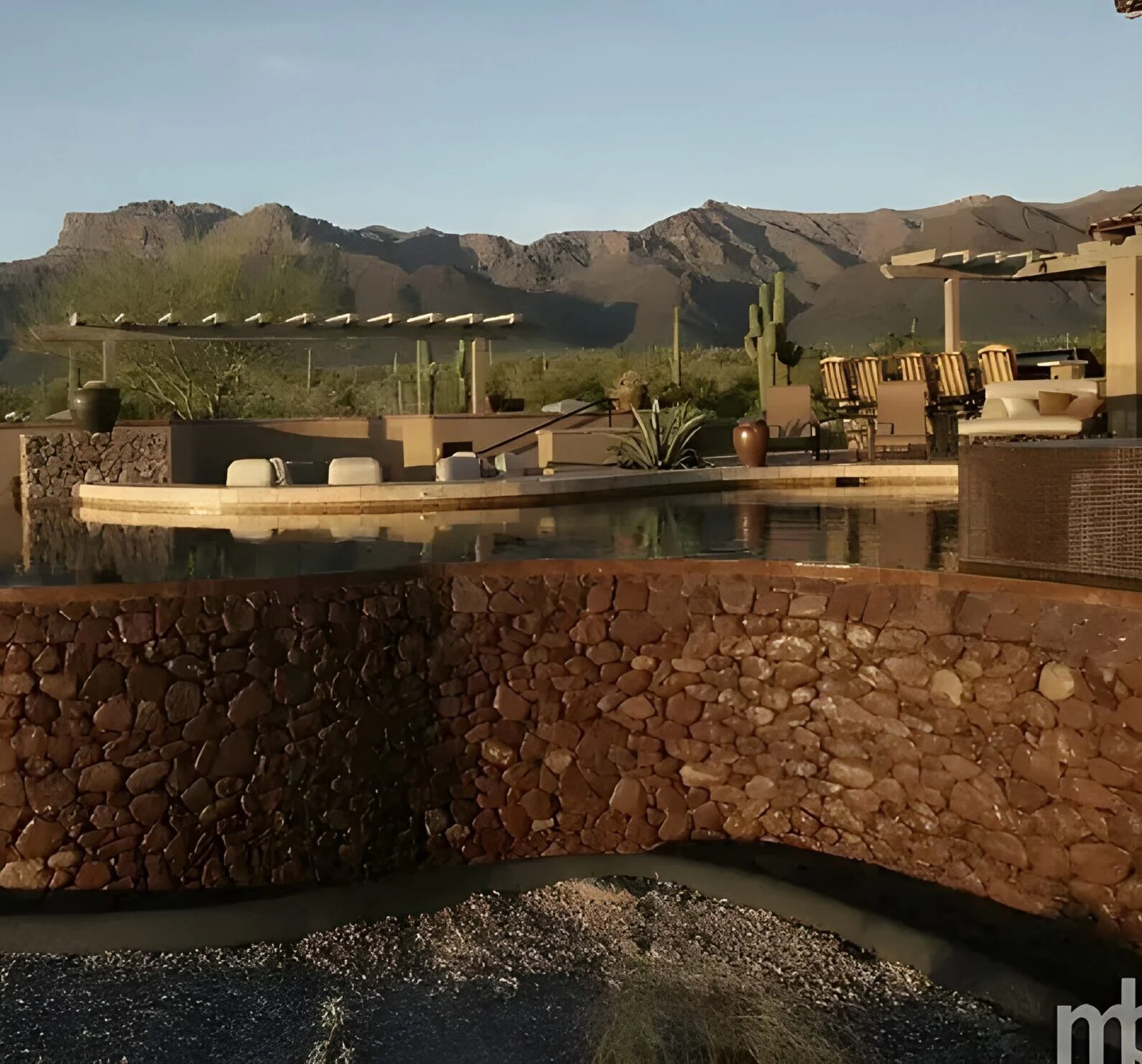
What does $80K–$120K get you in Scottsdale?
At this investment level, you’re building a quality custom concrete pool designed for your specific lot and lifestyle. This tier represents the entry point for serious custom work in Scottsdale’s market—not production-builder packages, but a genuine design-and-build relationship with meaningful customization.
What’s typically included:
- Pool sized 350–500 sq ft (roughly 15’×25′ to 18’×28′)
- Standard geometric or modest freeform shape
- PebbleTec or PebbleSheen interior finish in a standard color palette
- 400–600 sq ft of concrete or paver decking
- Pentair variable-speed pump, cartridge or sand filter, basic automation
- LED underwater lighting (2–3 fixtures)
- Standard coping
- Permits and inspections
What’s typically at the boundary or excluded at this tier:
- Attached spa (adds $15K–$25K+)
- Water features (adds $3K–$15K+ depending on type)
- Fire features
- In-floor cleaning systems
- Smart home automation integration
- Premium decking materials (travertine, natural stone)
- Negative-edge or perimeter overflow designs
This tier serves families who want a beautiful, well-built pool that will last for decades, without pushing into the feature-intensive territory that drives costs into the next band. It’s also the most common starting point for pool remodels and resurfacing projects on existing concrete shells.
If your lot has difficult site conditions—confirmed caliche, limited access, or significant slope—you may need to plan 10–15% contingency above your initial estimate. We’ll always tell you what we find during site evaluation before any contract is signed.
What does $120K–$200K get you?
This is the most popular range for Mossman Brothers projects, and it’s where Scottsdale’s custom pool market most clearly separates from the production-builder segment. At this level, you’re moving from “a nice pool” to a genuinely designed outdoor living experience.
What’s typically included:
- Pool sized 500–700 sq ft (roughly 18’×28′ to 20’×35′)
- More complex shapes: freeform lagoons, architectural geometric designs with spa bays, L-configurations, or single-edge infinity designs
- PebbleTec or PebbleSheen in the full color range, including glass-bead accent bands
- 600–900 sq ft of travertine or paver decking
- Pentair IntelliCenter automation system with app control
- IntelliChlor salt chlorination
- LED color-changing underwater lighting (4–6 fixtures)
- Sheer descent waterfall or rock feature
- Attached spa with spillover
- Baja shelf or tanning ledge
- Fire bowls (1–2)
- Landscape lighting integration
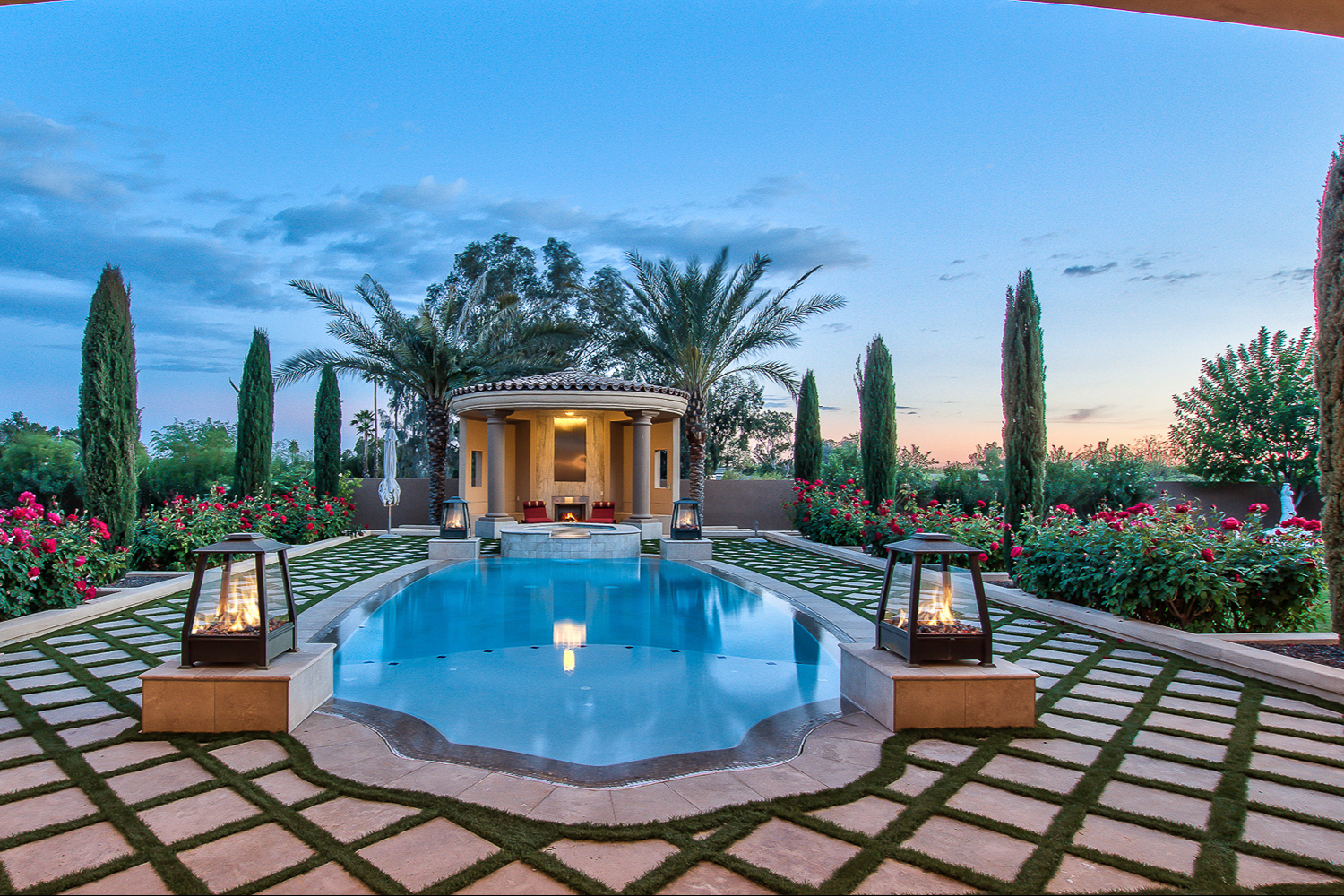
What this tier looks like in practice: A 550 sq ft freeform pool with PebbleSheen finish, travertine decking, an attached raised spa with a waterfall spillover, two fire bowls, and Pentair IntelliCenter automation. This is what most people picture when they imagine a “Scottsdale luxury pool”—and what you actually get when you work with a boutique builder who designs every project from scratch.
Most of the pools that have won us World’s Greatest Pools recognition sit in this range or above. The awards aren’t about the budget—they’re about design intentionality, execution quality, and how the pool integrates with its property. A $150K pool designed thoughtfully will always outperform a $200K pool assembled from a parts list.
→ Learn more about our freeform lagoon designs
→ See our straight-line geometric pool portfolio
Not sure which tier fits your project?
Jeff has spent 33 years helping Scottsdale homeowners match their vision to their budget. A 30-minute consultation is the fastest way to get a real number for your specific lot.
What does $200K–$350K get you?
At this level, the pool becomes the defining feature of the property. Projects in this range typically combine a large, technically sophisticated pool design with premium finishes, an integrated spa, multiple water and fire features, high-end decking, and Pentair’s full automation suite.
What’s typically included:
- Pool sized 700–1,000 sq ft
- Multi-edge negative-edge infinity designs, large freeform lagoons with grottos, or elaborate wet-edge perimeter overflow designs
- PebbleBrilliance glass-bead finish, full glass tile accent lines, or combination finishes
- 900–1,500 sq ft of premium decking (travertine, natural stone, or large-format porcelain)
- Full Pentair IntelliCenter i10PS automation with multi-zone control
- In-floor cleaning system (must be installed during original construction)
- Integrated saltwater system with heat pump or gas heater
- Multiple sheer descent or waterfall features
- Attached infinity spa with fire and water integration
- Multiple fire bowls or a gas-fired fire pit
- Outdoor kitchen rough-in or full build
- Swim-up bar or submerged seating areas
- Beach entry / zero-entry transition
- Full landscape lighting design
Site complexity at this tier: Many Paradise Valley and Silverleaf properties in this investment range involve hillside engineering, retaining walls, and infinity edges designed around specific mountain views. These add meaningful cost—but they also produce pools that have legitimately no equivalent in production-builder portfolios.
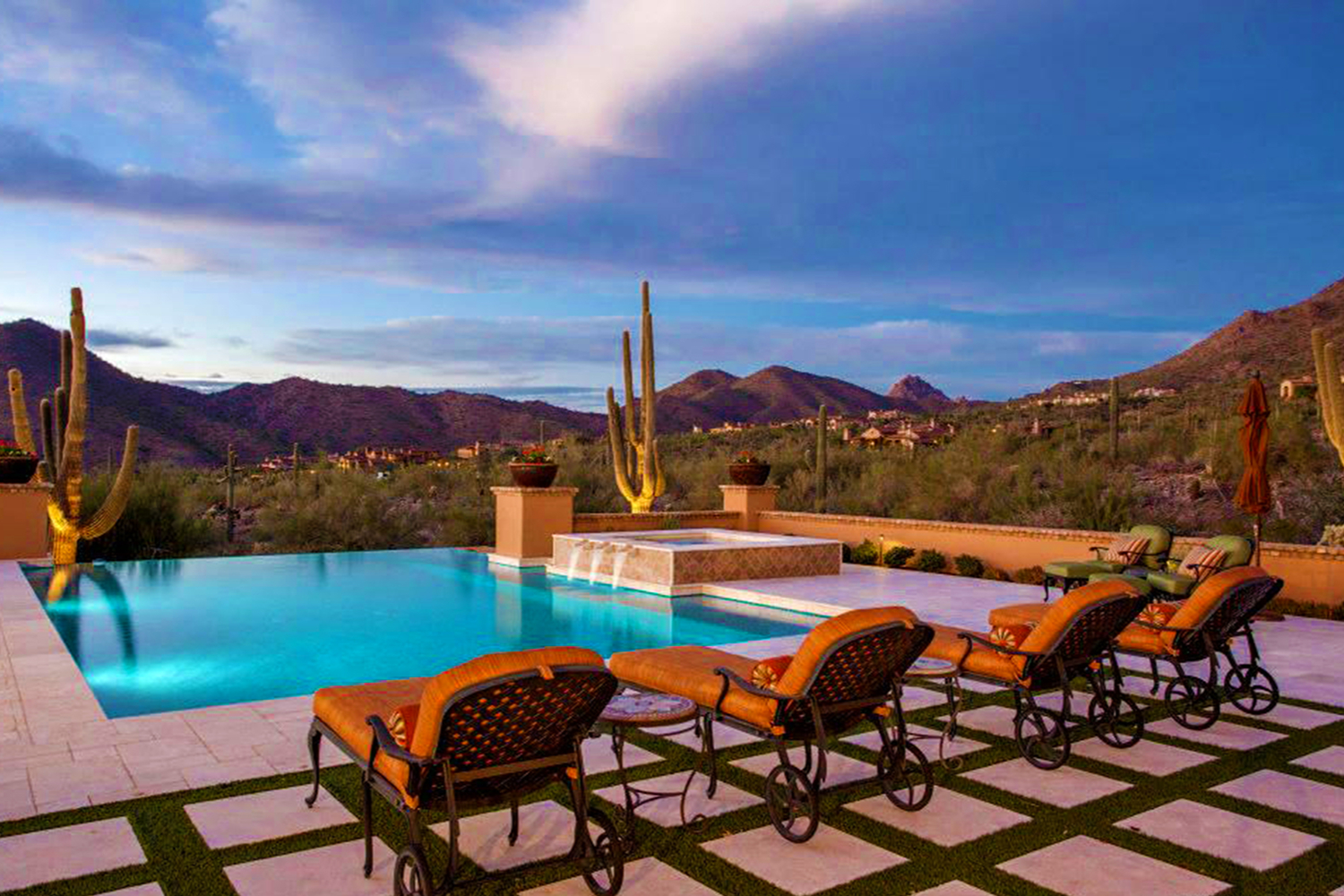
→ Understanding infinity pool engineering and costs
→ What makes a wet-edge perimeter overflow pool different
What does $350K–$500K+ get you?
These are statement projects. Multi-acre lots in Paradise Valley, Silverleaf, and DC Ranch, where the pool is one component of a complete outdoor living environment that might include a pavilion, outdoor kitchen, fire lounge, bocce court, and full landscape master plan. At this level, the pool itself might be 1,000–1,500+ sq ft, feature all-four-edge perimeter overflow design, full glass tile interior, a dedicated infinity spa, fire-and-water features, and a Pentair automation system integrated with the home’s smart home platform.
Mossman Brothers has built in this range, and these projects are where the 33 years of design knowledge matters most. The engineering is genuinely complex. The precision requirements for wet-edge perimeter overflow pools—level to within 1/32 of an inch across all four edges—are unforgiving. A builder without extensive experience in these designs will produce results that are immediately visible and expensive to correct.
If your project is in this range, the conversation starts with a site visit, not a brochure.
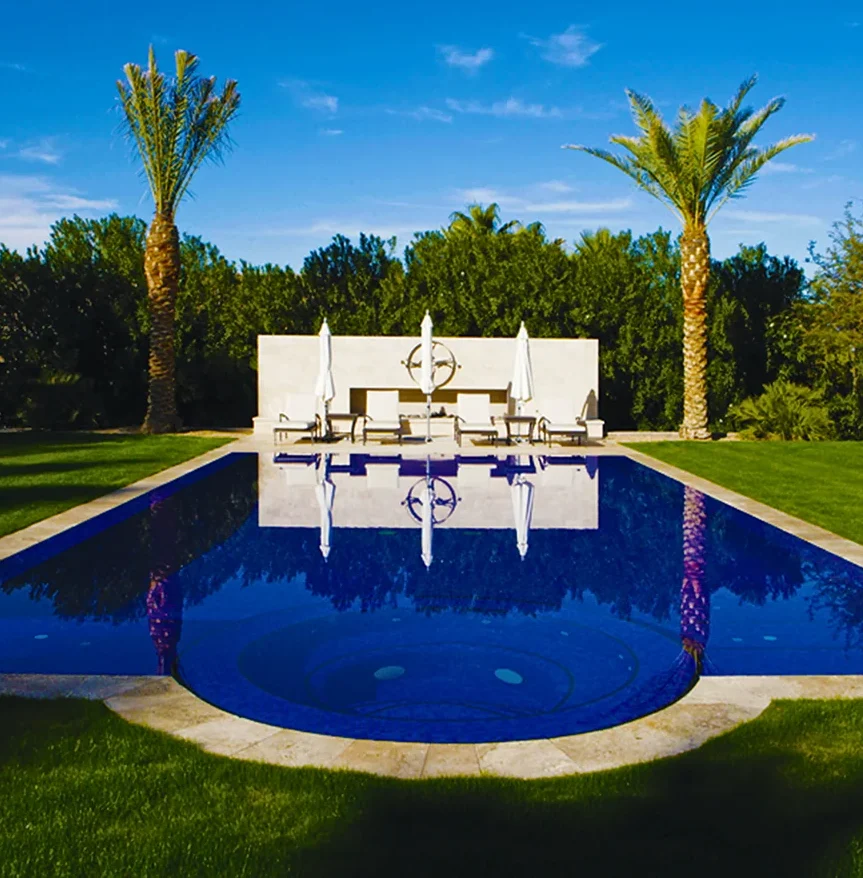
Projects at this level start with a site visit
Jeff meets you at your property, evaluates the lot, and gives you a real picture of what’s possible. No template proposals. No generic estimates.
How does pool design style affect your investment?
The design style you choose isn’t just an aesthetic decision—it’s a structural and engineering decision that affects everything from excavation complexity to equipment sizing.
Negative-edge infinity pools
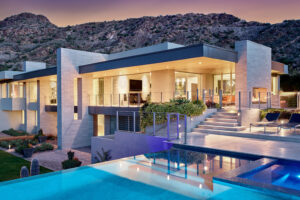
The most requested design in Scottsdale’s luxury market, and the most technically demanding to build. Negative-edge pools require a precisely engineered collection trough behind the vanishing edge, a recirculation system calibrated to maintain the continuous overflow effect, and an edge that’s level to fractions of an inch across its full length. Single-edge infinity designs are more accessible in terms of cost; multi-edge designs require proportionally more engineering and construction time.
Mossman Brothers has won multiple World’s Greatest Pools awards specifically for infinity pool design. We’ve built these on flat lots and hillside properties, with mountain views and city light sight lines. The design approach changes significantly based on site.
→ Complete guide to infinity pool design and construction costs
Freeform lagoon pools
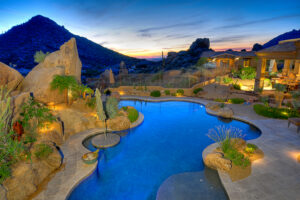
Organic shapes, beach entries, multiple depth zones, and natural stone integration define this category. The shape itself doesn’t dramatically increase cost over a geometric pool of equivalent size—the cost drivers are features: elaborate rock waterfalls, grottos, extensive native planting integration, and multi-zone depths. Freeform pools integrate naturally with Scottsdale’s desert landscape and complement Mediterranean, Tuscan, and Southwestern architectural styles particularly well.
→ Our freeform lagoon design portfolio
Straight-line geometric pools
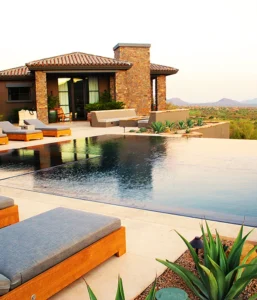
The cleanest, most architecturally precise option. Rectangles, squares, and combined geometric configurations that echo your home’s structural language. These photograph beautifully from above and integrate naturally with contemporary and mid-century modern architecture. Geometric pools are generally the most cost-efficient path to a large swimming surface, since simple shapes minimize formwork complexity and coping runs.
→ Modern geometric pool designs
Wet-edge perimeter overflow pools
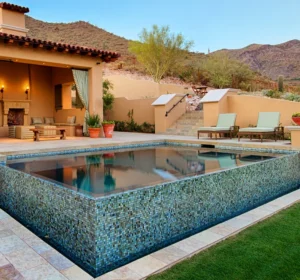
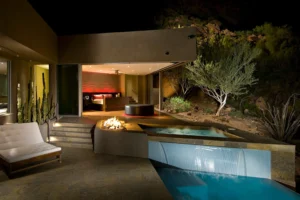
The rarest and most expensive residential pool type. Water cascades continuously over all four edges into a perimeter collection trough—a constant movement of water that creates an effect unlike anything else in residential design. These require the highest level of structural precision, the largest circulation equipment, and experienced builders who have actually done them before. Very few builders in Arizona have the track record in wet-edge design that Mossman Brothers does.
→ Wet-edge perimeter overflow: engineering and investment guide
What features and upgrades should you budget for?
Every feature below is a genuine investment in how you use and experience the pool—not decoration. The question isn’t whether to include them; it’s which ones align with your lifestyle and how you prioritize the budget.
Attached spa
An attached spa—whether a spillover spa at pool level or a raised spa with a cascade into the pool—is the single highest-impact feature for daily use. In Arizona’s climate, a heated spa extends comfortable outdoor use through December through February, when pool water drops below comfortable swimming temperatures. Plan for $15,000–$40,000 depending on size, height, tile work, and jet configuration.
Water features
Sheer descent waterfalls produce a thin, glassy sheet of water that falls into the pool. They’re visually striking, work beautifully with negative-edge designs, and produce soothing ambient sound. Cost: $1,500–$5,000 each.
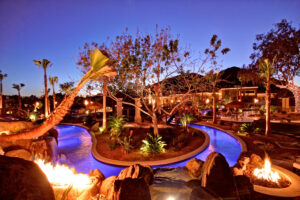
Rock and stone waterfalls create a more naturalistic cascade and integrate well with freeform lagoon designs. Cost: $5,000–$20,000+ depending on scale and stone work.
Deck jets and bubblers add movement and visual interest at lower cost. Cost: $500–$1,500 each.
→ Complete water features and pool amenities guide
Fire features
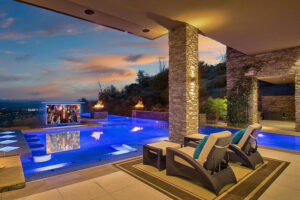
Fire bowls, fire pits, and fire-and-water combination features extend your outdoor season and create the kind of ambiance that makes a pool area feel like a resort destination. Gas-plumbed fire features require a gas line run during construction—retrofitting is expensive. Plan for fire during the original design phase.
Entry-level fire bowls: $1,000–$3,000 installed. Premium fire bowls or combination fire-and-water features: $3,000–$8,000+. Built-in fire pit or outdoor fireplace: $5,000–$20,000+.
Pool lighting
Underwater LED lighting transforms the pool at night and extends the hours it’s usable and enjoyable. Modern LED systems (Pentair IntelliBrite) allow full color control from your phone through the same automation app that controls your pump, heater, and water features. Budget $400–$800 per LED fixture, plus landscape lighting integration at $2,000–$6,000 for a comprehensive design.
Automation and smart control
Pentair’s IntelliCenter automation system is standard on every Mossman Brothers pool at the $120K+ tier. It controls pump speed, filtration cycles, heater temperature, water features, and lighting from a single app. For homes with Alexa or Google Home integration, pool control can be voice-activated. The system also monitors equipment health and alerts you to issues before they become failures. This isn’t a luxury—it’s how modern pools should be operated.
→ Pool automation and smart technology guide
Baja shelf and tanning ledge
A shallow (8–12 inch) ledge in the pool that accommodates a lounge chair, young children, or a large-breed dog. Practically useful and visually clean when integrated into the design. Add: $2,500–$8,000 depending on size and finish treatment.
In-floor cleaning system
A return-jet-based cleaning system that circulates debris toward the main drain without a robotic cleaner. Must be designed and installed during original construction—it cannot be retrofitted. For pools with complex shapes, beach entries, or tanning ledges, in-floor systems provide coverage that manual cleaning can’t replicate. Cost: $8,000–$15,000+.
Decking and coping
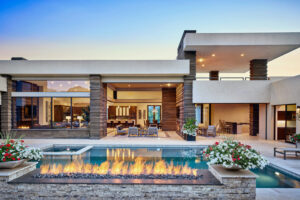
Decking is the surface you walk on; coping is the edge cap around the pool perimeter. Both affect how the pool looks and feels, and both need to handle Arizona’s extreme summer heat. Some materials—certain concrete and dark pavers—become too hot to walk on barefoot in July. Travertine is the most popular choice in Scottsdale’s luxury market: it stays cooler underfoot than most alternatives, drains quickly, and pairs naturally with both desert and Mediterranean landscaping. Large-format porcelain pavers offer a contemporary look with excellent durability. Natural stone (limestone, flagstone) is premium and requires more maintenance.
Budget $15–$27 per square foot for travertine installed; $20–$40 for natural stone. For a typical 800 sq ft deck, that’s $12,000–$32,000 in decking alone.
→ Pool decking materials guide for Arizona homeowners
Scottsdale-specific factors that affect what you’ll spend
This is where national pool cost guides fail Scottsdale buyers. The generic numbers you find online are built around national averages that don’t account for desert site conditions, local permitting, or Arizona’s unique climate demands on pool construction.
Caliche soil: the factor nobody mentions until you’re under contract
Caliche is a calcium carbonate deposit found throughout the Sonoran Desert. It ranges from soft, chalky material that excavation equipment handles easily to rock-hard formations that require pneumatic hammers, specialized rippers, or additional equipment. You won’t know exactly what’s under your backyard until we’re in it.
Most reputable Arizona builders—including Mossman Brothers—include standard excavation in their base contract and handle hard caliche as a disclosed change order. Expect $2,800–$5,000+ for a hard caliche hit. In extreme cases involving crane-assisted material removal, the surcharge can exceed that. This is why we recommend a 10–15% contingency buffer for Scottsdale projects, particularly in North Scottsdale, Paradise Valley, and Cave Creek where caliche depth and hardness vary significantly even within a single neighborhood.
We’ll tell you what we find during site evaluation. No surprises after the contract is signed if we can help it.
→ Arizona soil conditions and pool construction: what Scottsdale homeowners need to know
Scottsdale permitting and HOA architectural review
Pool construction in Scottsdale requires permits from the City of Scottsdale Development Services. Projects involving specialty features—infinity edges, raised spas, significant grading changes—require engineering calculations at submittal. Permit costs typically run $300–$1,200 depending on project scope and municipality (costs differ in Paradise Valley, Fountain Hills, and unincorporated Maricopa County).
If your home is in a master-planned community—DC Ranch, Troon, Gainey Ranch, McCormick Ranch, Silverleaf—your project will also require approval from the homeowners association’s architectural review committee before permits can be applied for. ARC timelines vary by community from two weeks to 60+ days. Factor this into your construction start date planning.
Mossman Brothers handles all permit applications, engineering coordination, and inspection scheduling. You won’t need to navigate city or county building departments yourself.
→ Complete guide to pool permits and HOA approval in Scottsdale
Arizona pool barrier requirements
Arizona law (A.R.S. § 36-1681) requires a minimum 5-foot barrier around any pool. Gates must be self-closing and self-latching, with the latch positioned at least 54 inches off the ground. No opening through which a 4-inch sphere can pass is permitted. Short-term rental properties (Airbnb, VRBO) must have a primary perimeter fence plus a secondary barrier around the pool itself.
These requirements apply to all pools built after July 20, 1995. If you’re building a new pool, barrier installation is part of the project and must pass inspection before water is added. Budget $2,000–$10,000 for barrier installation depending on material (aluminum, wrought iron, glass panel, or removable mesh) and linear footage required.
Extreme heat, monsoons, and design considerations unique to Arizona
Decking surface temperature. In Scottsdale’s summer, dark pavers and certain concrete finishes can exceed 150°F surface temperature. Material selection isn’t just aesthetic—it’s a comfort and safety decision. Travertine, cool deck concrete, and light-colored natural stone are the standard choices for Arizona pools precisely because they manage heat differently than alternatives.
Monsoon drainage. Arizona’s summer monsoon season (June–September) delivers intense, short-duration rainfall that can dump an inch of water in 20 minutes. Pool decks and surrounding hardscape need to be graded and drained to manage this volume. Poorly designed drainage becomes a maintenance and structural problem. We design for monsoon conditions as a standard part of every project.
Evaporation. An uncovered Arizona pool loses an average of 20,000 gallons of water per year to evaporation—roughly 4–6 feet of water annually. In drought conditions, Scottsdale and surrounding municipalities have periodically restricted landscape irrigation; pool water replacement is generally still permitted but should be factored into ownership planning. Pool covers reduce evaporation by up to 90%. We can discuss cover options during design.
Construction timing. Arizona pools can be built year-round, which is a genuine advantage over most of the country. Summer construction involves heat management for crews and concrete curing—not a problem for experienced builders, but worth knowing. Most clients who want summer completion target a spring construction start.
What does the construction process look like—and how long does it take?
No competitor covers this in their cost guide. But luxury buyers spending $150K–$300K+ want to understand exactly what they’re signing up for before construction starts, not after.
Phase 1: Design and consultation (2–4 weeks) Every Mossman Brothers project begins with a site visit. Jeff evaluates the lot, discusses your vision, reviews your home’s architectural character, and identifies any site constraints. From there, design development produces initial concepts—multiple directions showing how different approaches could work on your specific property. You’ll see 3D visualization before anything is built.
Phase 2: Design refinement and final approval (1–3 weeks) Revisions happen here. Most clients do one to two revision rounds before landing on a final design. Final approval triggers the next phase.
Phase 3: Permitting and engineering (2–6 weeks) Permit applications go to the City of Scottsdale (or relevant municipality). Projects requiring engineering calculations—infinity edges, hillside designs, raised spas—are submitted with those calculations. HOA architectural review happens in parallel if applicable. Timing here is largely outside our control, though we have extensive experience navigating local requirements efficiently.
Phase 4: Construction (8–14 weeks for standard projects; 12–20 weeks for complex designs)
The construction sequence for a concrete pool:
- Staking and layout
- Excavation
- Steel rebar placement and structural inspection
- Gunite or shotcrete application
- Plumbing rough-in (suction and return lines, water features, spa jets)
- Electrical rough-in (lighting conduit, equipment conduit)
- Coping and tile setting
- Equipment installation (pump, filter, heater, automation, salt cell)
- Decking and hardscape
- Interior finish (PebbleTec application)
- Fill and startup chemistry
- Equipment commissioning and “pool school” — we walk you through how everything works
Total design-to-swim timeline: Plan for 16–26 weeks for a standard project from initial consultation to first swim. Complex designs with HOA review and specialty engineering run longer. We give realistic timelines at the contract stage—not optimistic promises that create frustration.
Ready to see what’s possible on your property?
The process starts with a site visit — no cost, no commitment. Jeff will evaluate your lot and give you a real picture of what your project looks like from design through completion.
How to finance a custom pool in Arizona
Most Scottsdale luxury pool buyers use one of three financing approaches.
Home equity line of credit (HELOC). For homeowners with significant equity, a HELOC is typically the lowest-rate option and offers flexibility—draw as needed through the construction process, pay interest only during the draw period. Current HELOC rates (March 2026) average 7.04% variable. The application process takes 30–45 days, so start early if you plan this route.
Pool-specific lenders. Companies like Lyon Financial and HFS Financial specialize in pool financing, offering fixed-rate unsecured loans up to $200,000 with terms as long as 30 years. Fixed monthly payments give you predictability; rates currently run 7.19%–8.49% depending on credit score and term. A $150,000 pool financed over 15 years at 7.19% runs approximately $1,365/month—comparable to a luxury vehicle payment, for an asset that stays with your property.
Cash. A meaningful percentage of our clients fund pool projects through cash or liquid investment proceeds. For projects in the $200K+ range on properties where the pool adds significant property value, many clients view this as a straightforward capital allocation decision.
We’re happy to discuss financing approaches during consultation and can provide referrals to lenders who work regularly with Arizona pool buyers. What we don’t do is pressure you toward a financing decision—that’s a personal choice we respect.
→ Pool financing options for Arizona homeowners
Does a pool increase your home’s value in Scottsdale?
In most U.S. markets, a pool adds 5–8% to a home’s value. In Scottsdale’s luxury market, the math is more favorable than that national average suggests—and the reasons are worth understanding.
Year-round usability. With 299 sunny days per year and swimming weather from April through October (often March and November for heated pools), a Scottsdale pool gets used. A pool that sits covered nine months per year in a northern climate is a liability. A pool in use eight-plus months per year is a lifestyle amenity with real market demand.
Buyer expectation in luxury segments. In neighborhoods like Silverleaf, DC Ranch, and Paradise Valley, a luxury home without a pool is harder to sell than one with a pool. Buyers at the $1.5M–$5M+ price point expect the outdoor living ecosystem—pool, spa, fire features, outdoor kitchen. A property without one often requires a price concession to account for what buyers will need to spend themselves.
Investment framing vs. expense framing. Consider the alternative math: a country club or resort membership that gives you consistent pool access might cost $10,000–$25,000 per year. Over 10 years, that’s $100,000–$250,000 in access fees with no residual asset value. A $150,000 custom pool is owned, appreciates with the property, and is available whenever you want it.
The honest answer is that pools built to Mossman Brothers’ quality standard—concrete construction, premium finishes, award-winning design—hold their value better than production-builder pools, which may need significant renovation within 15–20 years. The long-term financial picture favors quality upfront.
What are the ongoing costs of owning a concrete pool in Arizona?
Building the pool is the first investment. Owning it well requires planning for ongoing costs that are predictable and manageable.
Professional maintenance. Weekly service from a licensed pool maintenance company typically runs $100–$200/month in the Phoenix metro—$1,200–$2,400/year. Service includes chemical testing and balancing, skimming, brushing, and filter inspection. Arizona’s hard water and intense UV create specific chemistry demands that benefit from professional management.
→ Arizona pool maintenance: what desert pool owners need to know
Chemicals and supplies. If you maintain your own pool, expect $50–$100/month in chemicals—more during summer when heat accelerates chlorine burn-off and algae growth. Salt systems (like Pentair IntelliChlor) reduce annual chemical spend significantly but require salt cell replacement every 3–7 years at $400–$900.
Energy. A variable-speed Pentair pump running optimized cycles typically costs $50–$150/month in electricity—substantially less than older single-speed equipment. If you heat the pool with a gas heater, plan for $200–$500/month during heating periods. Heat pump heaters are more efficient for Arizona’s mild winters, running $50–$150/month when active.
Long-term capital costs. PebbleTec finishes are rated for 15–20 years. Resurfacing a 600 sq ft pool typically runs $12,000–$24,000. Standard plaster would need to be done every 7–12 years at $5,000–$15,000. The PebbleTec premium pays back in extended resurfacing intervals. Equipment lifespans with proper maintenance: pumps 10–15 years, filters 10–15 years, heaters 10–15 years, salt cells 3–7 years.
Annual ownership estimate. Plan for $3,000–$5,000/year in operating costs without active heating. Factor in one equipment replacement or significant repair every 5–7 years.
Why the builder you choose matters as much as the budget
A $150,000 pool built by a builder with 33 years of custom concrete experience is a fundamentally different product than a $150,000 pool built by a company that treats it as a volume transaction.
The difference shows up in how the design is developed (custom for your lot, or adapted from a template), in how site conditions are handled (transparently disclosed, or absorbed into a rushed schedule), in the quality of the concrete work and finish application, and in who you’re talking to when something needs attention after completion.
Mossman Brothers Pools builds 40–50 pools per year. Not 400. Not 1,200. That’s by design. Jeff handles every design consultation. Our crews aren’t juggling 20 simultaneous projects. The pool you’re paying for gets the attention it requires.
The 11 World’s Greatest Pools awards from PebbleTec aren’t participation trophies. They’re judged by an independent panel of design editors from a pool of thousands of North American entries. They reflect what happens when a boutique builder with genuine design expertise builds at the highest level of execution—and does it again and again over three decades.
If you’re comparing quotes and ours isn’t the lowest, that’s worth understanding rather than dismissing. We’re happy to walk through what’s included, what quality decisions we’ve made, and why we believe the investment makes sense. We’d rather lose the project to a competitor than win it by cutting corners on your behalf.
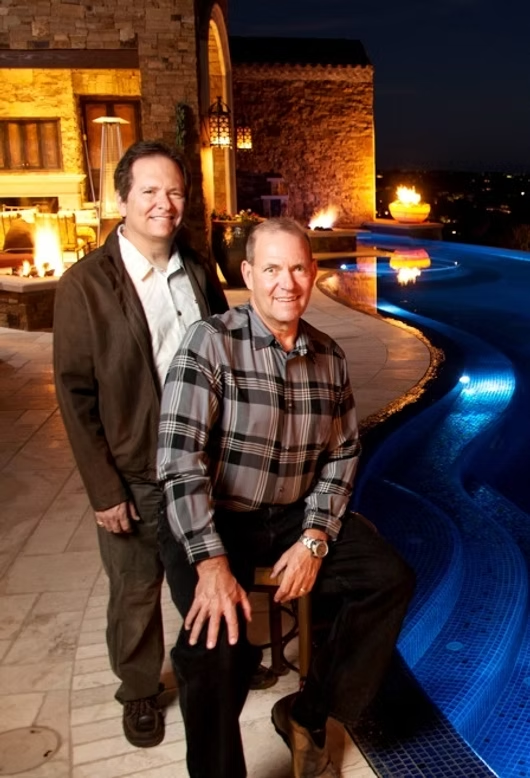
→ About Mossman Brothers Pools: Our story and philosophy → Schedule a free design consultation
Frequently asked questions
How much does a custom concrete pool cost in Scottsdale? Custom concrete pools in Scottsdale range from approximately $80,000 for a standard geometric pool to $500,000+ for a complex luxury design with a full outdoor living environment. Most custom projects from boutique builders in Scottsdale’s luxury market fall between $120,000 and $300,000. The final cost depends on size, design style, site conditions, finishes, features, and equipment tier. A site evaluation is the only way to give you an accurate number for your specific property.
How long does it take to build a custom pool in Arizona? From initial consultation to first swim, plan for 16–26 weeks for a standard project. Simple geometric pools with straightforward site conditions can be completed in 12–16 weeks. Complex designs—infinity edges, hillside engineering, HOA review requirements, large-scale outdoor living projects—typically run 20–30+ weeks. Arizona’s year-round construction climate means you can build in any season; summer starts are common.
Does Mossman Brothers Pools build fiberglass or vinyl liner pools? No. Every pool we build is custom concrete—gunite or shotcrete. Concrete is the only construction method that allows full design freedom, any size or shape, any depth configuration, and the kind of long-term durability that justifies the investment levels our clients make. Fiberglass shells are pre-manufactured in limited factory shapes. Vinyl liner pools require periodic liner replacement. Neither approach can produce the infinity edges, perimeter overflow designs, or award-winning freeform lagoons in our portfolio.
What is caliche and how does it affect pool construction costs? Caliche is a calcium carbonate deposit found throughout the Sonoran Desert. When it’s present in your excavation area, it can turn a standard one-day dig into a three-to-five-day operation requiring pneumatic hammers and specialized equipment. We always disclose hard-dig conditions and price them separately as a change order rather than building in a large contingency that you pay for regardless of what we find. Most Scottsdale properties encounter some caliche; serious hard-dig conditions requiring major cost adjustments occur in a minority of projects.
What are Arizona’s pool fence requirements? Arizona law (A.R.S. § 36-1681) requires a minimum 5-foot barrier around all pools. Gates must be self-closing, self-latching, with the latch at least 54 inches off the ground. No opening larger than a 4-inch sphere is permitted through the barrier. Short-term rental properties have additional secondary barrier requirements. Mossman Brothers coordinates barrier installation and ensures your pool passes required safety inspections before water is added.
What PebbleTec finish should I choose? PebbleTec Original, PebbleSheen, and PebbleBrilliance (glass bead) each offer different visual effects, all in 40+ colors. Original provides a naturally textured aggregate look with excellent durability. PebbleSheen has smaller pebbles for a smoother feel. PebbleBrilliance uses glass beads for a reflective, jewel-like effect. Jeff will walk you through color selection with real material samples during the design process—color looks very different in a sample card versus in a full pool with water.
Can I add an outdoor kitchen or living space to the project? Yes. We design and coordinate complete outdoor living spaces—pools, spas, fire features, water features, outdoor kitchens, landscape lighting, and hardscape—as integrated projects rather than a pool with additions bolted on. The best outdoor spaces are designed as a unified vision from the start, not assembled piecemeal. If outdoor kitchen or living space is in your plans, mention it in the first consultation so we can design the space holistically.
How does Scottsdale’s hard water affect my pool? Arizona’s water supply is significantly higher in dissolved minerals (calcium, magnesium) than most of the country. In a pool, this accelerates calcium scaling on surfaces and equipment, requires more aggressive chemical balancing, and eventually necessitates a partial or full water replacement to reset total dissolved solids. Proper PebbleTec finishes handle Arizona water better than standard plaster. Pentair IntelliChlor salt systems reduce the chemical management burden. Professional weekly maintenance is especially valuable in Arizona’s climate—the chemistry is genuinely more demanding than in other regions.
How do I get an accurate estimate for my project? The most accurate way is a site visit with Jeff. Pool estimating from lot dimensions and a phone conversation has meaningful uncertainty—especially in Scottsdale, where site conditions, HOA requirements, and lot configuration can each move the number significantly. We offer free design consultations that include a site evaluation. You’ll leave with real information about your project, not a range wide enough to be meaningless.
Ready to talk about your pool?
Jeff Mossman has been designing custom pools in Scottsdale for over 33 years. If you’re serious about a pool project—whether you’re actively planning or still in the early thinking stage—a conversation is the right starting point.
No high-pressure sales. No template proposals. Just honest expert advice about what’s possible on your property and whether we’re the right builder for your project.
Ready to talk about your pool?
Jeff Mossman has been designing custom pools in Scottsdale for over 33 years. Whether you’re actively planning or still in the early thinking stage, a conversation is the right starting point. No pressure. No templates. Just honest expert advice.